
Get monthly updates on FP&A best-practices and more.
How to Build Your 2027 Budget Without Burning Your Whole Fourth Quarter
It's late August, and somewhere in your inbox there is a message from your CEO or your board chair with the words "2027 plan" in it, along with a date that felt generous when you first read it and feels considerably less generous now.
The arithmetic is worth doing out loud. If your board wants an approved 2027 budget by the middle of November, you need roughly two weeks after the first read for revisions, three weeks before that for department heads to send you numbers they will actually defend, and another week to reconcile what they send against what your ledger says. Work backward from November and you are starting in September rather than October.
Most finance teams at companies between $10M and $100M in revenue lose the entire fourth quarter to this process. It doesn't have to go that way, but staying out of that hole depends on a handful of decisions you make before the first template goes out.
Start from your 2026 misses instead of a blank file
The worst version of budget season begins with an empty spreadsheet and a growth assumption that somebody said out loud in a meeting six weeks ago.
A better starting point is your own variance report. Pull your 2026 budget against actuals by month and find the three largest gaps, not all of them, just the three that moved the most money. For most companies the list reads something like this: hiring came in later than planned, a revenue line missed by fifteen percent in the second quarter and nobody re-forecast it, and one vendor category grew forty percent while everyone was looking somewhere else.
Those three misses are the most useful thing you own right now, because they show you exactly where your assumptions run structurally optimistic. They also give you something concrete to say when a department head asks why their number came in below what they requested. Telling someone you budgeted twelve hires last year and made seven of them by October is a far better conversation than telling them finance pushed back.
Build three cases rather than a dozen scenarios
Scenario planning has been oversold to finance teams for about a decade. Teams build eleven versions of the model, present two of them, and use none of them once January arrives.
Three cases is the number that survives contact with an operating meeting. Your base case covers what happens if the business does roughly what it is doing today against the pipeline you can actually see. Your downside case shouldn't be an apocalypse, because nobody plans around an apocalypse; pick one specific thing that could plausibly go wrong, such as your largest customer choosing not to renew or your best revenue line growing zero percent instead of twenty, and show what has to happen to spending if it does. That tends to be the case your board remembers. Your upside case covers what you would need to hire and spend to serve growth you can't see yet, and how much of that spending you can hold back until you can.
Each case needs a hiring plan and a cash floor attached to it, and not much else. If you can't explain a case in two sentences, it isn't going to get used.
Budget the drivers, not the line items
Line-item budgeting is how finance teams end up with a four-hundred-row spreadsheet that takes most of a day to update.
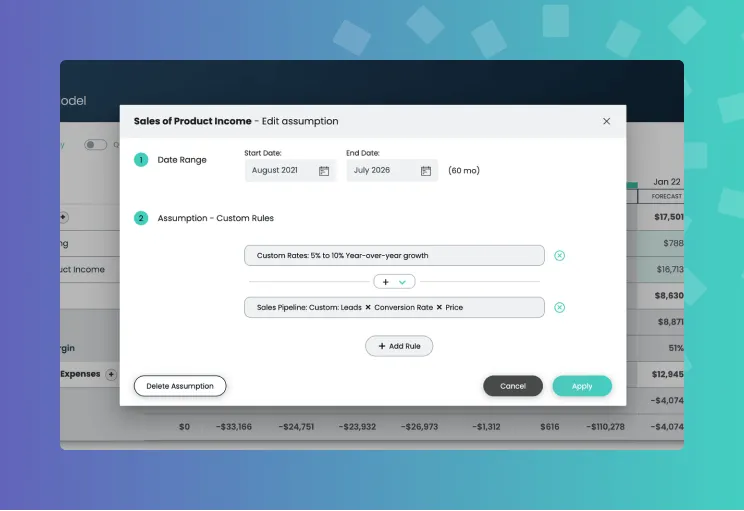
The alternative is identifying the handful of drivers your P&L genuinely runs on. At this size that usually comes down to five or six inputs: headcount by team with start months, average fully loaded compensation, price, volume, retention, and a couple of variable cost ratios. Nearly everything else can reasonably be a percentage of something else or a flat monthly figure.
There's a simple test for whether you've done this. When your sales leader tells you in February that two enterprise deals have slipped a quarter, how long does it take you to see what that does to cash in September? If you can answer within a day, your model runs on drivers. If you need until Thursday, it runs on line items.
Decide now what you'll re-forecast, and when
This is the step almost everyone skips, and it's the one that pays off next year.
Before you finish the budget, put four re-forecast dates on the 2027 calendar and write down what actually changes at each one. A reasonable version looks like this: the full year gets re-forecast at the end of every quarter, the hiring plan gets revisited monthly, and revenue gets re-forecast monthly for the current quarter only.
You don't have to move all the way to a rolling forecast to capture most of the value here. You only have to put in writing that the November budget isn't the final word, because it won't be, everyone in the room already knows it won't be, and pretending otherwise is the main reason budgets get ignored by March.
Put a name on every number before you present it
A budget line without a name attached to it is a suggestion.
Every meaningful cost center should have a person who agreed to the number in a conversation you can point back to later. Do that work before the board read rather than after it. Those extra September meetings are tedious, but they eliminate an entire genre of second-quarter conversation that opens with somebody insisting they never agreed to that number.
The part that actually eats the quarter
Very little of budget season is strategy. Most of it is chasing four people for a hiring plan, reconciling a department's spreadsheet against the general ledger, discovering that somebody reclassified a vendor in QuickBooks back in June, and rebuilding a tab because the file you were working from turned out not to be the current one.
That's the work that swallows the fourth quarter, and it's worth naming, because it's also the work that no longer has to be done by hand.
Clockwork pulls directly from QuickBooks and Xero, so your budget gets built against your live ledger instead of an export from three weeks ago, and re-forecasting means changing a driver instead of rebuilding a model. Mira, our AI analyst, writes the variance commentary and flags the reclasses and anomalies you'd otherwise turn up in November.
Fourteen days is enough to get a 2027 model built on your real numbers before September is over, which, given the calendar above, is roughly when you need it.
Conclusion
Very little of budget season is strategy. Most of it is chasing four people for a hiring plan, reconciling a department's spreadsheet against the general ledger, discovering that somebody reclassified a vendor in QuickBooks back in June, and rebuilding a tab because the file you were working from turned out not to be the current one.
That's the work that swallows the fourth quarter, and it's worth naming, because it's also the work that no longer has to be done by hand.
Clockwork pulls directly from QuickBooks and Xero, so your budget gets built against your live ledger instead of an export from three weeks ago, and re-forecasting means changing a driver instead of rebuilding a model. Mira, our AI analyst, writes the variance commentary and flags the reclasses and anomalies you'd otherwise turn up in November.
Fourteen days is enough to get a 2027 model built on your real numbers before September is over, which, given the calendar above, is roughly when you need it.




.png)





.png)



.png)
.png)

.avif)


.avif)





.avif)

.webp)




.avif)


.png)
.avif)


.avif)


.avif)