
Get monthly updates on FP&A best-practices and more.
There’s a stage in every growing company where the numbers are technically “covered,” but strategically unsupported.
The books are closed.
Payroll runs.
Tax filings are handled.
Reports are delivered.
But key questions remain unanswered:
- Can we afford to hire?
- How long is our runway?
- What happens if revenue slows?
- Should we invest in growth right now?
This is the finance gap, and it affects both businesses and the accounting firms that support them.
The Reality for Growing Companies
Most small and mid-sized businesses don’t have a full-time CFO.
And many don’t need one yet.
But they do need:
- Forward-looking forecasts
- Scenario planning
- Visibility into cash and burn
- A structured way to evaluate decisions
Without that, business owners make major decisions based on:
- Bank balance
- Gut instinct
- Outdated spreadsheets
- Static annual budgets
That works, until complexity increases.
New hires.
Pricing changes.
Debt.
Investor pressure.
Expansion.
When that happens, reactive finance isn’t enough.
The Reality for Accounting Firms
Accounting firms are increasingly being asked strategic questions:
- “Can I afford this hire?”
- “What does my cash look like in 6 months?”
- “What if revenue dips 15%?”
- “Should we take on debt?”
Clients want forward-looking answers.
But most accounting systems are built around historical reporting, not dynamic forecasting.
Even the best advisory-focused firms face a challenge:
Strategic modeling is time-consuming and spreadsheet-heavy.
And spreadsheets don’t scale well across multiple clients.
The Shared Opportunity
The opportunity isn’t to replace accountants.
And it’s not to push businesses into hiring a full finance team too early.
The opportunity is to give both parties better infrastructure.
When businesses and their advisors have access to:
- Real-time financial visibility
- Automated, continuously updating forecasts
- Scenario planning that can be adjusted in minutes
- Alerts when key metrics move
Conversations shift from reactive to strategic.
Instead of:
“We’ll see how this month closes.”
It becomes:
“Here’s what the next 6 months look like under three scenarios.”
That changes the quality of decisions.
What Strategic Finance Should Look Like
Whether you’re a business owner or an advisor, strong financial infrastructure should allow you to:
1. Stress-Test Growth Decisions
Before hiring:
- What does this do to cash?
- How long until this role pays for itself?
- What’s our runway under conservative revenue assumptions?
2. Monitor Leading Indicators
Revenue variance.
Burn rate.
Margin shifts.
Headcount costs.
You shouldn’t have to wait until month-end to know something changed.
3. Model “What If” in Minutes
What if:
- Revenue drops 10%?
- Pricing increases 5%?
- Churn spikes?
- We delay hiring by 60 days?
If it takes days to model, decisions get delayed — or made without clarity.
A Practical Exercise for Both Businesses and Advisors
Here’s a simple framework that’s valuable for any client right now:
Run a 3-Scenario Planning Exercise.
- Base Case — current forecast
- Conservative Case — revenue down 10–15%
- Growth Case — hiring ahead of plan
Then ask:
- How does runway change?
- When does cash get tight?
- What hiring decisions become risky?
- What expenses are flexible?
If that exercise is difficult or spreadsheet-heavy, that’s usually a sign the finance system needs strengthening.
Where Infrastructure Makes the Difference
The biggest shift we’re seeing across both businesses and accounting firms is this:
Finance is moving from reporting to real-time decision support.
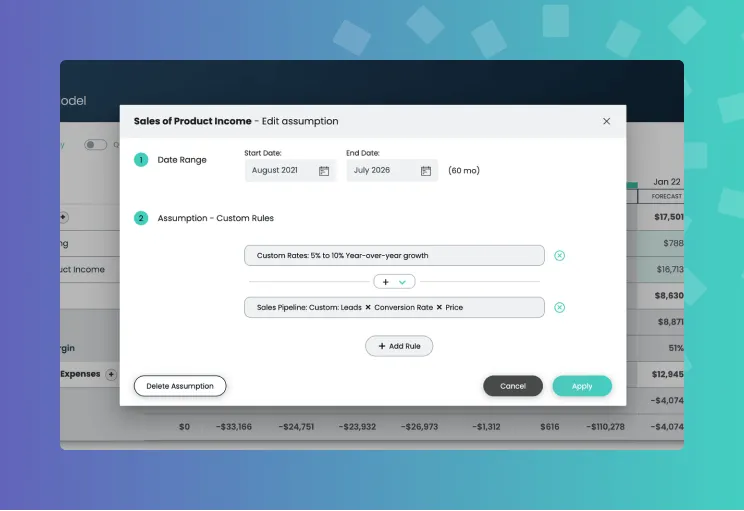
Tools like Clockwork provide:
- Automated forecasting tied to live financial data
- Scenario modeling that’s easy to update
- Visibility into runway, burn, and margin
- AI-driven insights (via Mira) to help interpret what changed
- Smart alerts when metrics move beyond thresholds
For businesses, this means operating with CFO-level clarity before hiring a CFO.
For accounting firms, it means delivering scalable advisory without rebuilding models from scratch for every client.
It strengthens the partnership — instead of replacing it.
The Bottom Line
Strong financial infrastructure doesn’t replace expertise.
It amplifies it.
When business owners have clarity and advisors have better tools, decisions improve.
Risk decreases.
Conversations elevate.
Growth becomes intentional — not accidental.
And that’s value both sides can stand behind.
Conclusion
The Bottom Line
Strong financial infrastructure doesn’t replace expertise.
It amplifies it.
When business owners have clarity and advisors have better tools, decisions improve.
Risk decreases.
Conversations elevate.
Growth becomes intentional — not accidental.
And that’s value both sides can stand behind.





.png)





.png)


.png)
.png)

.avif)


.avif)





.avif)

.webp)




.avif)


.png)
.avif)


.avif)


.avif)