Get monthly updates on FP&A best-practices and more.
Cash runway is how long a business can operate at current burn before running out of cash, usually expressed in months. Cash buffer is a separate reserve of cash held above operating needs to absorb shocks like a delayed customer payment, an unplanned hire, or a slow quarter. They look like the same number when a business is burning cash and operators often treat them as one figure. They diverge as soon as the business turns cash-positive: runway becomes effectively infinite, but the buffer still matters because it is the cushion for an unexpected expense or revenue dip.
TL;DR: Cash runway vs. cash buffer
Cash buffer is the amount of cash a business keeps in reserve to cover operating expenses if revenue stops, usually measured in days the business could survive with zero income. Cash runway is the number of months a business can operate before it runs out of cash at its current burn rate.
- Cash buffer = Bank Balance ÷ Average Daily Cash Outflows, answers "how long can we survive with zero revenue?"
- Cash runway = Bank Balance ÷ Monthly Burn Rate, answers "how many months until we run out of cash?"
- Use cash buffer when you're profitable and stress-testing for a downturn.
- Use cash runway when you're burning cash and planning the next fundraise.
The reason these get confused is that they look the same on the surface (cash divided by something), but the "something" is different. Runway uses your net burn (cash out minus cash in). Buffer uses your gross outflows (cash out only, as if revenue evaporated). One number tells you when you run out of cash; the other tells you what happens if customers stop paying tomorrow.
I learned the difference as an outsourced CFO. One client was a $4M ARR services firm celebrating 14 months of runway. Then their largest customer signed a 90-day payment-term renewal and pushed $200K of expected cash into Q2. Runway said "fine." Buffer said "you have 11 weeks of operating cash if that one customer slips an invoice." Buffer was the right number to plan against. Here's when each metric earns its keep, and how to calculate both without rebuilding a spreadsheet every Friday.
Cash runway vs. Cash buffer
Cash runway and cash buffer have become popular because they're easy to calculate, and they can tell you a lot about your business, but it's not enough to just calculate these metrics and toss them up on a dashboard. You need to understand what they're really telling you, why you'd use one over the other, and what their limitations are, before you start using them to guide your real-world business decisions.
Cash runway
Cash runway is a common metric among startups, because it's meant for companies with negative monthly cash flow (or cash "burn"). Usually these companies are young and unprofitable, but they've gotten an investment, so they can afford to spend more money than they make, while they build up enough revenue to eventually become profitable.
Cash runway is a critical metric for these companies because it shows them how much longer they can operate before they are either out of business, or they need to raise another round of funding. Cash runway is typically calculated by taking your current Bank Balance divided by your monthly cash Burn Rate, and the result tells you how many months are left until you're out of cash.
- Cash Runway (months) = Bank Balance / Monthly Burn Rate
You can figure out your monthly Burn Rate simply by looking at how much your bank balance decreases each month, which makes cash runway super easy to calculate. However, it has a few limitations.
The most important drawback to be aware of is that your historical burn rates aren't always going to be consistent going forward. If your burn rate will increase in the future (e.g. you're planning to hire more staff or spend more on marketing than you did in the past), your cash runway calculation could indicate that you have 12 months until you run out of cash, when you'll actually only have 6 months. If you used the 12 month figure to guide business decisions, you could run into serious trouble.
Cash buffer
Cash buffer is a more appealing metric to profitable companies, or companies with a relatively long cash runway, who want to get an idea of how long their business could survive in a worst-case scenario, if they completely stopped generating revenue.
Cash buffer is calculated by taking your current Bank Balance divided by your cash outflows only (i.e. as if you didn't collect any revenue). The result tells you how many days your business could survive without revenue.
- Cash Buffer = Bank Balance / Average Daily Cash Outflows
The larger your cash buffer, the larger your financial cushion. But it's not always true that bigger is better. Sometimes excess cash is a bad thing, because it means you're not reinvesting enough money back into your business. An oversized cash buffer could give you peace of mind knowing that you can survive a worst-case scenario, so you'll need to strike a balance.
Additionally, as with cash runway, a major drawback of cash buffer is its reliance on historical numbers, which can either over- or under-state your true "cash buffer" depending on how your spending will change in the future.
Are there other options?
Yes. The most reliable way to understand your cash flows, predict your future bank balance, and see how your finances would react in best- and worst-case scenarios, is to build a cash flow forecast.
Building a cash flow forecast is a lot more involved than calculating cash runway or cash buffer, but it's also significantly more accurate and useful for decision-making. Every business, profitable or not, in good or bad times, should have a cash flow forecast in some form.
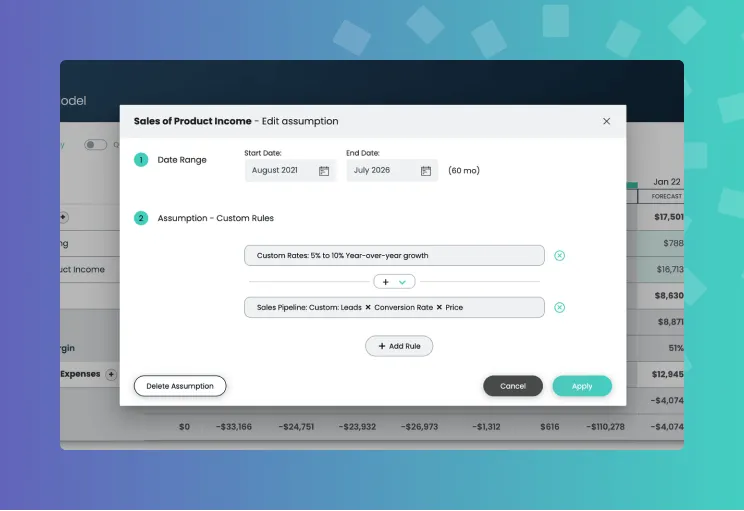
A good cash flow forecast takes historical trends into account, but it also incorporates your own assumptions about the future, like changes to headcount, revenue growth, funding, etc. This makes it more accurate and useful, because it doesn't just tell you "this is what will happen if current trends continue," but rather "this is what will happen based on the way your business typically behaves, AND what you expect to happen in the future."
The most powerful feature of a good cash flow forecast is the ability to adjust your assumptions to build scenarios. For example, if your baseline assumption is 5% monthly revenue growth, but you're curious what would happen to your cash if revenue fell 10%, you could build multiple forecasts under those different assumptions, so you know what would happen and you're ready in case things don't go as planned.
There are plenty of articles online that will teach you how to build a cash flow forecast in spreadsheets, but doing this all by hand is a big lift. Not only is there a high risk of human error, but you'll also need to constantly update the forecast as new results come in. Most importantly, you'll need to understand all of the nuanced cash flow behavior in your business, which is difficult even for the most seasoned finance professionals.
How Clockwork Can Help
Clockwork is an AI-powered FP&A platform that securely connects to your accounting system (QuickBooks or Xero), learns from patterns in your transactional data, and automatically builds a 5-year financial model and 52-week cash flow forecast that you can easily customize with your own assumptions about the future.
It updates every hour, adjusts your forecasts based on new information, and lets you build unlimited scenarios with a few clicks, so you can get the full picture of your financial past, present, and future, without spending hours in spreadsheets or clunky tools that take weeks to implement. You'll still be able to track your cash runway and cash buffer on Clockwork's real-time metrics dashboard, but you'll also get a whole lot more without any manual setup required.
Clockwork offers a 14-day free trial, and current rates are published on the pricing page. Book a demo or start your free trial to see if it's right for your business.
Conclusion
Cash runway & cash buffer have become popular because they’re easy to calculate but you need to understand what they’re really telling you and when to use them.





.png)





.png)



.png)
.png)

.avif)


.avif)





.avif)

.webp)




.avif)


.png)
.avif)


.avif)


.avif)