
Get monthly updates on FP&A best-practices and more.
The short answer: for most small businesses running on QuickBooks or Xero, Clockwork is the best FP&A software in 2026 — it delivers forecasting, scenario planning, and an AI analyst at transparent SMB pricing without requiring a finance team to run it. We ranked the eight tools below on price accessibility, ease of setup, QuickBooks/Xero integration depth, and how much finance expertise each one assumes you have.
FP&A (financial planning and analysis) software turns your accounting data into forward-looking answers: cash flow forecasts, budgets vs. actuals, scenario models, and board-ready reports. The catch is that most FP&A platforms were built for dedicated finance teams at mid-market companies, with pricing to match. This list focuses on what actually works for small businesses — and is honest about which tools you should skip until you're bigger.
The 8 best FP&A software tools at a glance
- Clockwork — Best overall for QuickBooks/Xero SMBs without a finance team. Published SMB pricing, 14-day free trial.
- LiveFlow — Best for live QuickBooks reporting in Google Sheets and Excel. From $500/month.
- Jirav — Best for SMBs with a dedicated in-house finance owner. From roughly $10,000/year.
- Mosaic — Best for VC-backed startups with a strategic finance team. Pricing on request.
- Fathom — Best for management reporting and KPI tracking. From $50/month.
- Reach Reporting — Best for visual reporting, especially for accounting firms. From $149/month.
- Cube — Best spreadsheet-native FP&A for growing finance teams. Premium tier around $2,450/month.
- Datarails — Best for Excel-heavy finance departments. Custom pricing, typically from ~$30,000/year.
1. Clockwork — best FP&A software for small businesses overall
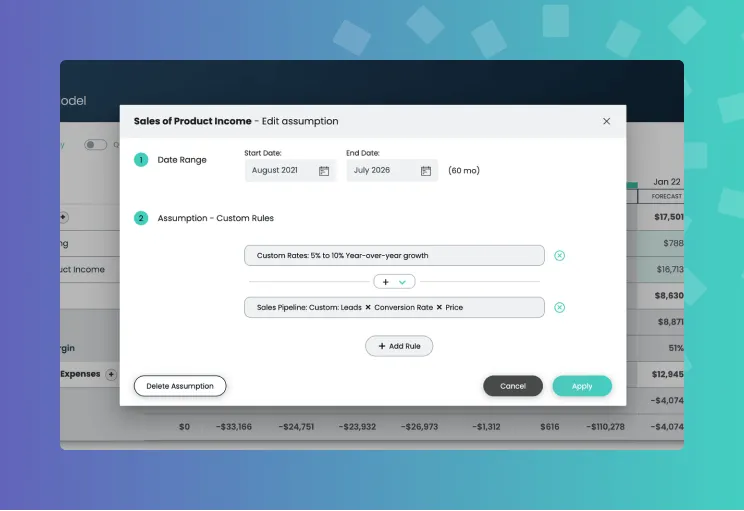
Clockwork is AI-powered FP&A software built specifically for small businesses on QuickBooks (Online and Desktop) and Xero. Connect your accounting file and Clockwork automatically builds a live financial model, weekly cash flow forecast, and customizable dashboards — no spreadsheet engineering, no implementation project, no consultant required. Its AI analyst, Mira, answers plain-English questions about your numbers, runs scenarios ("what happens if we hire two people in Q3?"), and flags trends you'd otherwise miss.
What makes Clockwork the top pick for this list is who it's designed for: owners, operators, and fractional CFOs at companies that don't have a full finance team. Most tools here assume an analyst will live in the platform daily. Clockwork assumes nobody will — so the software does the analyst work itself. Pricing is also refreshingly simple: a single published monthly rate for the full platform, with no seat fees, no forecast limits, and a 14-day free trial that doesn't require a credit card. Accounting and CFO firms get pooled multi-client wholesale pricing. Current rates for both are on the pricing page.
Best for: small businesses on QuickBooks or Xero that want real forecasting and scenario planning without hiring a finance team.
Starting price: published on the Clockwork pricing page; 14-day free trial.
Limitation: it's purpose-built for QuickBooks and Xero businesses — if you run NetSuite or another mid-market ERP, or need multi-layer departmental approval workflows, an enterprise platform will fit better.
2. LiveFlow — best for live reporting in Google Sheets and Excel
LiveFlow pipes live QuickBooks and Xero data into Google Sheets and Excel, so the reports and consolidations you build update automatically instead of being copy-pasted every month. It's especially strong for multi-entity consolidation, rolling up several QuickBooks files into one set of statements.
Best for: finance-savvy teams and accountants who want to keep building custom models in spreadsheets, but with live data.
Starting price: from $500/month (three users), and costs scale with entities and users.
Limitation: it's a data pipeline more than a planning platform — you still have to build and maintain the forecasts and models yourself in spreadsheets.
3. Jirav — best for SMBs with a dedicated finance owner
Jirav is a driver-based planning platform offering budgeting, forecasting, dashboards, and reporting, with solid QuickBooks and Xero integrations. It's popular with accounting and CFO advisory firms, which can access discounted wholesale per-client pricing.
Best for: small and mid-sized businesses with someone in-house (a controller or finance lead) who can own the platform and build the model.
Starting price: around $10,000/year for the Starter plan when bought directly; firm wholesale pricing is much lower per client.
Limitation: there's a real learning curve and setup lift — without a dedicated owner, much of the platform's power goes unused.
4. Mosaic — best for VC-backed startups with finance teams
Mosaic is a strategic finance platform that connects your ERP, CRM, HR, and billing systems to deliver real-time dashboards, headcount planning, and SaaS metrics out of the box. It's a genuinely impressive product — for the right company size.
Best for: funded startups and mid-market companies with at least one full-time strategic finance hire and multiple data systems to connect.
Starting price: pricing on request; reported contracts typically run well into five figures annually.
Limitation: it's overkill for a typical small business on QuickBooks — both the price and the setup assume a finance team is driving it.
5. Fathom — best for management reporting and KPI tracking
Fathom connects to QuickBooks, Xero, and MYOB to produce polished management reports, KPI scorecards, and benchmarking, with forecasting added in recent years. Pricing tiers are based on the number of company files, with unlimited users on every plan.
Best for: businesses and advisors who primarily need beautiful monthly reporting packs and KPI tracking.
Starting price: from $50/month.
Limitation: its roots are in reporting and analysis — forecasting and scenario planning are less deep than dedicated planning tools, and costs climb as you add company files.
6. Reach Reporting — best for visual reporting at accounting firms
Reach Reporting combines financial statements, dashboards, and a spreadsheet engine into highly visual reports, and connects to QuickBooks, Xero, and Excel. Unlimited users and client portals on every plan make it a favorite of bookkeeping and advisory firms.
Best for: accountants and fractional CFOs producing visual report packages for multiple clients.
Starting price: $149/month for one data connection; multi-connection bundles lower the per-client cost.
Limitation: it leans toward reporting and presentation — budgeting and forecasting are workable but lighter than planning-first platforms.
7. Cube — best spreadsheet-native FP&A for growing finance teams
Cube layers a real FP&A engine — data consolidation, scenario analysis, approval workflows, audit trails — on top of the Excel and Google Sheets your team already uses. It also offers AI agents for variance analysis and forecasting.
Best for: companies graduating from pure spreadsheets that have a finance team ready to own a planning process.
Starting price: tiered plans, with the popular Premium tier around $2,450/month.
Limitation: at that price point and complexity, it's built for businesses with dedicated finance staff — most small businesses won't get their money's worth yet.
8. Datarails — best for Excel-heavy finance departments
Datarails automates consolidation, reporting, and planning for teams that live in Excel, pulling data from accounting, ERP, and CRM systems into a governed database behind your existing spreadsheets. Its FP&A Genius AI adds chat-based analysis on top.
Best for: small-to-mid-sized finance departments with deeply entrenched Excel models they don't want to rebuild.
Starting price: custom pricing — reported contracts typically start around $30,000/year plus implementation.
Limitation: no public pricing, annual contracts, and a formal implementation process put it out of reach for most genuinely small businesses.
How to choose FP&A software for your small business
Most bad FP&A purchases happen when a small business buys a tool built for a company three times its size. Use these five criteria to avoid that:
- Match the tool to your team, not your ambitions. If nobody on staff will spend hours a week in the platform, choose software that automates the analyst work (like Clockwork or Fathom) rather than a platform that requires it (like Cube or Mosaic).
- Check integration depth with your accounting system. A native, two-way QuickBooks or Xero sync that pulls full transaction detail beats a generic connector that imports summary balances once a day.
- Demand transparent pricing. "Book a demo to see pricing" usually signals an enterprise sales motion, annual contracts, and a price designed for mid-market budgets. Tools that publish pricing tend to be priced for SMBs.
- Test time-to-value during the trial. The best SMB tools produce a usable forecast within a day of connecting your books. If a vendor quotes a multi-week implementation, that cost — in time and money — is part of the real price.
- Prioritize cash flow forecasting. For small businesses, cash is the metric that kills. Make sure the tool does granular (ideally weekly) cash forecasting, not just monthly P&L budgeting.
Frequently asked questions
What is the best FP&A software for small businesses?
For small businesses on QuickBooks or Xero, Clockwork is the strongest overall option in 2026: full forecasting, scenario planning, and an AI analyst at published SMB pricing with a 14-day free trial. Fathom is a strong pick if you mainly need reporting, and Jirav suits SMBs with a dedicated finance lead.
How much does FP&A software cost for a small business?
SMB-friendly tools run roughly $50–$500 per month (Fathom, Clockwork, Reach Reporting, LiveFlow). Platforms built for finance teams — Jirav, Cube, Datarails, Mosaic — typically cost $10,000 to $30,000+ per year, often with implementation fees and annual contracts.
Do small businesses really need FP&A software, or is Excel enough?
Excel works until it doesn't: forecasts go stale the moment they're built, formulas break silently, and updating actuals eats hours every month. If you're making hiring, pricing, or spending decisions on gut feel because the model is out of date, purpose-built software pays for itself quickly — especially tools that sync automatically with your accounting system.
What's the difference between FP&A software and accounting software?
Accounting software like QuickBooks or Xero records what already happened — invoices, bills, and historical statements. FP&A software sits on top of that data and looks forward: forecasting cash, modeling scenarios, comparing budgets to actuals, and answering "what happens if?" questions before you commit to a decision.




.png)





.png)



.png)
.png)

.avif)


.avif)





.avif)

.webp)




.avif)


.png)
.avif)


.avif)


.avif)