
Get monthly updates on FP&A best-practices and more.
How to add FP&A to a CPA firm without hiring an analyst
Short answer: pick five existing clients who already ask forward-looking questions, sell them a fixed monthly forecast and decision meeting, and let software build the model from their ledger so your current staff run the engagement in two hours a month instead of eleven. You do not need an FP&A hire to launch. You need a deliverable that builds itself and a partner willing to have the conversation.
I have watched a lot of firms try to add advisory by hiring first. It is the expensive way to learn what your clients will pay for. Here is the order that worked when I ran my own practice, and what I would do differently with the tools that exist now.
Step one: find the five clients who are already asking
You do not need a marketing plan to launch FP&A. You need to listen to the tax review calls. Somewhere in your book are clients who asked, this year, whether they could afford a hire, whether to take a loan, what would happen if they lost their biggest customer. Those clients have already told you they want forward-looking advice. They just did not have a line item to buy it under.
Make a list of five. Not fifty. Five clients where you know the owner, the business is growing or changing, and the books are in reasonable shape in QuickBooks Online or Xero.
Step two: decide what the deliverable is, and keep it small
The first version of the engagement is a 13-week cash flow forecast, a rolling 12-month view, budget versus actual with three sentences of commentary, and a 45-minute monthly meeting to walk through the decisions in front of them. That is it. No custom dashboards, no KPI framework, no board deck. Firms that overbuild the first deliverable never launch, because the build takes so long that the partner loses interest before the first invoice.
Price it in the middle band. For most small business clients that is $3,000 to $5,000 a month, fixed, with an annual increase in the letter.
Step three: do not build the model by hand
This is the step that determines whether you need an analyst or not. If the forecast lives in a spreadsheet, someone has to map the chart of accounts, build the three statements, reconcile them to the ledger, and refresh all of it every month. That is a week to set up and most of a day to maintain. Across five clients that is a full-time job, which is how firms talk themselves into the hire.
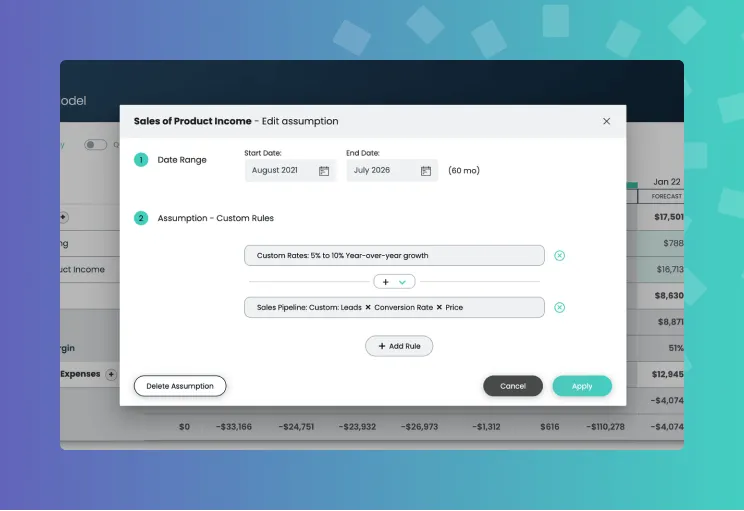
If the model builds itself from the ledger, the same five clients take your existing senior a couple of hours each per month, almost all of it reviewing what changed and preparing for the meeting. The forecasting engine does the assembly. The person does the advisory. That is not a small efficiency gain. It is the difference between needing a new salary and not.
The benchmark data says the same thing from a distance: CAS practices that invest in technology serve about 50 percent more clients per professional than practices that do not, and the practices with a CFO-level tier earn about 30 percent more per client per month.
Step four: run the first meeting like a CFO, not an accountant
The monthly meeting is the product. Open with the one thing that changed since last month. Show the cash view and name the week where it gets tight, if there is one. Put two decisions on the table and walk through the scenario for each. Close with what you will watch next month. Forty-five minutes. The client leaves having made or deferred a decision with numbers in front of them, which is something they have never had from an accountant before.
Do not present the model. Nobody wants to see the model. Present the answer and keep the model open in case they ask how you got there.
Step five: let the first five sell the next fifteen
Once five clients are paying a fixed monthly fee for forecasts and meetings, three things happen. Your staff now know how to run the engagement, so the next client is easier. You have a case study that is your own client and not a vendor's. And the five clients tell other owners, because "my accountant showed me I could afford the hire" is a sentence people repeat. That is when you decide whether to hire. Most firms find they do not need to until they pass 20 or 25 engagements, and by then the practice is paying for the person several times over.
What I would skip entirely
- A new brand or a separate advisory website. Your existing clients are the market for the first year.
- An FP&A certification program before you launch. Your senior staff already understand the numbers. What they lack is reps in the meeting, and the only way to get those is to have the meeting.
- Anything that requires an implementation. If the software needs a setup project, you have recreated the analyst problem with a vendor invoice attached.
Questions I get on this
Which staff should run it? A senior accountant or manager who already knows the client. Not the partner, after the first two meetings. The partner sells it and shows up quarterly.
What if the client's books are messy? Then the first month's deliverable is the cleanup, priced as such, and the forecast starts in month two. Messy books are a reason to start, not a reason to wait.
Do we need to be on a specific ledger? QuickBooks Online, QuickBooks Desktop and Xero cover most small business clients. Anything else can come in through an Excel import.
Conclusion
Where Clockwork fits
Clockwork is the FP&A platform built for step three. Connect a client's QuickBooks or Xero and the three statements, the weekly cash flow forecast, the 12-month view and the client reports exist that day. Mira, the AI analyst, drafts the variance commentary. No implementation, no analyst hire, and no per-seat fees, so the fifth client costs the same to add as the first. Clockwork is the Thomson Reuters FP&A partner.
Pick one of your five and bring the file to a 20-minute working session. You will leave with that client's forecast.




.png)





.png)



.png)
.png)

.avif)


.avif)





.avif)

.webp)




.avif)


.png)
.avif)


.avif)


.avif)